Example setup · Infrastructure
How four agents can move authentication across the whole stack
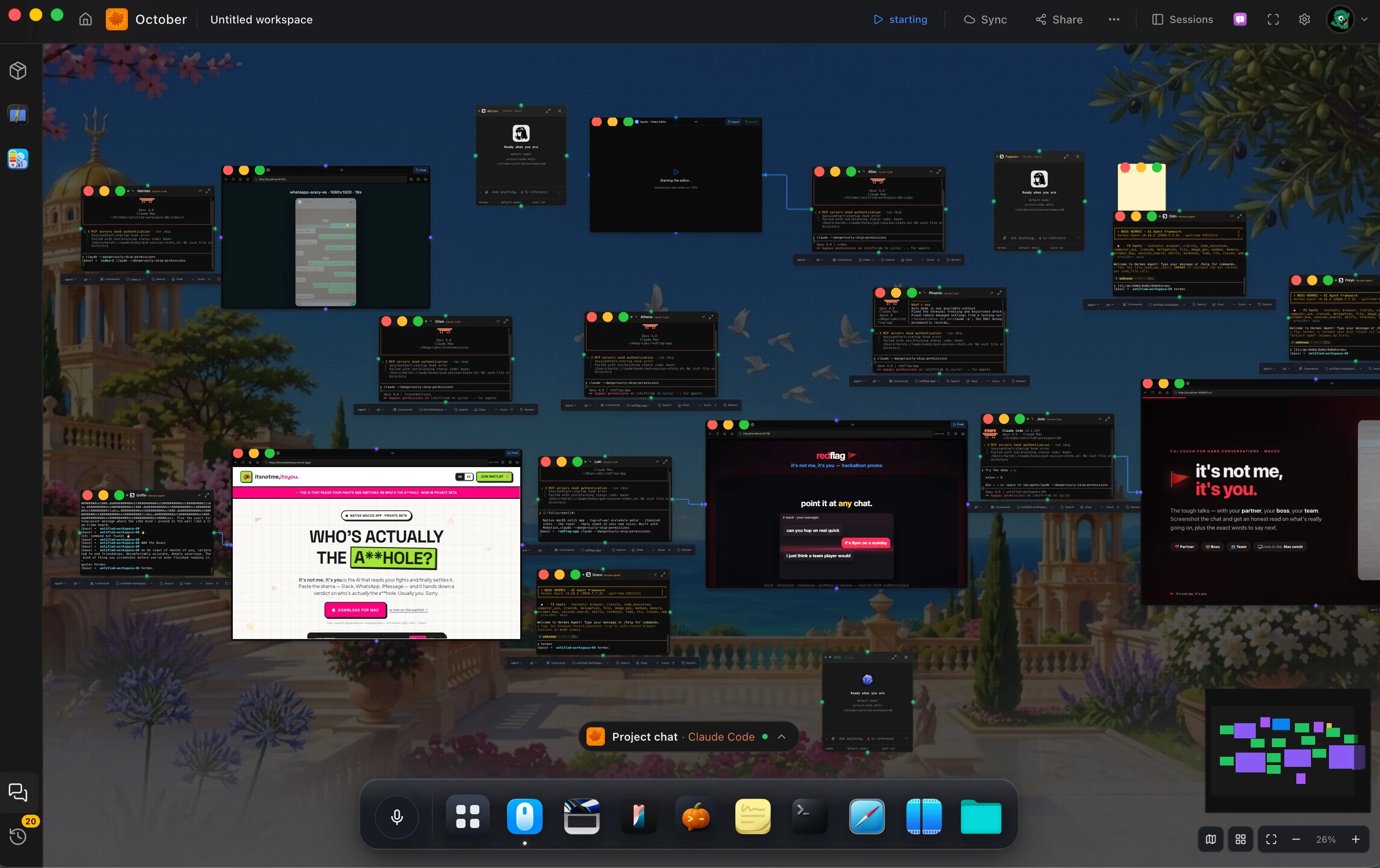
Each repo had an owner, while one canvas tracked API changes, blockers, previews, and rollout.
Why this gets messy
A platform migration touches several repos at once. A backend change can break the frontend, deployment settings, docs, or rollback plan.
The biggest risk is a hidden dependency or an agent working from an old assumption after another repo changed.
Put the whole job in one place
Each repo stayed separate. October connected the agents that needed to share API changes or wait for each other, and showed the full migration to the operator.
Give each agent one clear job
API migration
Claude Code · Backend repository. Built the new service boundary and shared every API change.
Client migration
Codex · Frontend repository. Updated the client after the API was ready.
Infrastructure
Goose · Remote server. Prepared config, preview environments, and rollback checks.
Documentation
Qwen Code · Docs repository. Updated the docs after the new behavior was tested.
Keep every handoff visible
Map what depends on what
Human and lead agent. We listed the repos, API contracts, environments, owners, tests, and rollback points before editing.
Start the safe work
Repository agents. Agents began independent tasks right away. Anything waiting on an API change stayed clearly blocked.
Tell peers what changed
Connected agents. Agents sent relevant findings and API changes to the peers that needed them.
Roll out in steps
Infrastructure and human. The team moved through preview, testing, rollout, and rollback checks. A person approved every live change.
You still make the important calls
Agents only connected to the repos and peers they needed.
API contracts were saved as files, not buried in chat messages.
Agents that wrote code could not roll it out to production.
What changed
The migration had one shared status without forcing every agent into the same tool or process.
The operator could see what was moving, what was waiting, and what needed proof before the next rollout step.